 Wired868 Wired868 for smart sport news and opinion
My father considered music of any kind to be unpleasant noise. In his later years, when he became a bible-toting Witness, he listened to some form of gospel. But as children, we were not allowed access for a long time. He was rough about it.
I came to really hear music in adolescence when he no longer lived with us. Then my mother unleashed her love for music. She sang daily, accompanying the hits on the radio.
I was maybe around 18 when I first heard a steelband. It was a Jouvay morning, and we were walking down the Eastern Main Road in San Juan, and in the cool morning air, this sound came like something magical in the dawn.
I do not exaggerate when I say it completely blew my mind. It changed my world. I am happy to report that more than four decades later, it still blows me away.
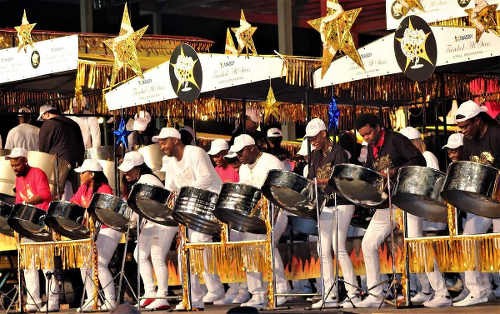
(via Island Talks)
I suppose it was not surprising that I fell in love with an All Stars panman. That was the year they played Curry Tabanca, that exhilarating arrangement by Leon “Smooth” Edwards with what seemed to be a symbolic addition of tassa drums as a nod to our relationship.
I still listen to it often, and each time I marvel and revel and feel proud and grateful to have such precious moments.
For years, I attended Panorama, visited panyards, and felt a sense of belonging to something that was uniquely ours. Motherhood, single motherhood, changed that drastically. I ended up having to watch it on TV.
In hindsight, it brought a different level of participation and deeper observation. It reminds me of the way watching cricket via television allows a whole different line of vision.

Photo: Pan Trinbago.
My back doesn’t like me sitting or standing around for long periods. It is very bossy in that regard. But it enables my fidgety nature because I can’t stay still. So I get to twist and turn about the house, peeing at my convenience, cooking, and just flitting around.
I suspect I am finding ways to console myself for not being physically there, but in truth, I am uncomfortable in crowds; it is too much of a sensory overload. Anyway, I have reconciled myself to watching two of my favourite things at home. I still never miss Panorama, and like a moth to light, I cannot help watching cricket, as dreary as it can be.
In those days, Gail and Brian used to collect me for pan. Alexa and I would provide each other with cricket commentary during matches. The three of them are gone now.
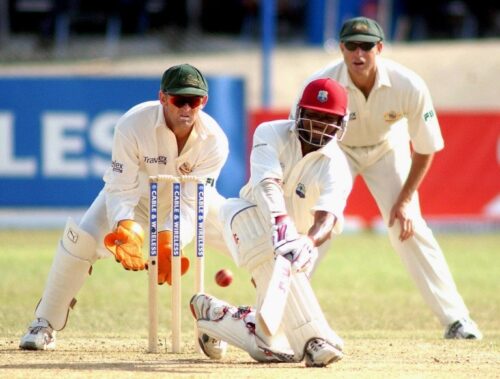
Behind stumps are Australian wicket keeper Adam Gilchrist (left) and Mathew Hayden. Lara made 91. Photo: AFP PHOTO/ Robert Taylor.
I’ve been thinking about how my relationship with pan changed from the days in the stands and on the drag. Younger, zesty, with a Stag and a cigarette (I stopped drinking Stag when they branded it a man’s beer), I would be absolutely immersed in the music, feeding off the crowd’s energy and just having a whale of a time.
The transition was to something more measured, watchful and analytic. I am no expert on music, can’t play any instrument. My attempt to play with Invaders ended when I realised just how hopelessly uncoordinated I am (it was the same with cricket).
I had to reconcile myself to the fact that I would have to settle for being a loving bystander. So, I came to be an observer. Watching steelbands over the years, I came to recognise aspects that were constant.

Via: Pan Trinbago
Inside the bands, the players exude joy, passion and astonishing dexterity. They are nimble, even those who look the least physically fit. They feed off each other’s energy, and they treat their conductors with all the respect one would expect of a fancy orchestra.
There is something so viscerally harmonious about their interactions that it is impossible not to discern it. And the composition of the members in terms of ethnicity is such a perfect representation of what constitutes our nation.
Pan has made room for everyone: race, colour, class, social background, gender, age. Wee ones, standing on boxes to reach the pans, side by side with grannies and grandpas; women on the bass, the tenors, the double seconds; men, boys; everybody has been embraced. And this embrace, this space that has been created without rancour, is one of the most magnificent accomplishments. A true redemption song.

Last night, I listened and watched several bands in their preparations for the finals. I listened to some of the youth players. It’s the same atmosphere. It is hard not to be constantly amazed at the sheer grandeur, not to get misty and choked up by the feeling that you are witnessing something majestic and that you are privileged to be in that presence.
As I said, I am no musical expert, though my life has been accompanied by a continuous soundtrack, but there is something to be revered in the talent of the arrangers and composers of the music they have gifted to the world.
I deliberately avoid calling names because to do so would make the others seem small, as David has told us. But if you reflect just a little on the massive corpus of excellence we have, you know that it is both astonishing and phenomenal—as our cricket once was.
I felt compelled to write this praise song because in these divisive times, we need to look past the nonsense and see the beauty that still lies within us.

In October 1995, I was part of a fellowship offered by the Committee to Protect Journalists. A dozen or so Read more

My bossy back demands an extreme degree of planning if I am to venture out. Sitting or standing for an Read more

In light of current general statements about economic diversification, it will not surprise my readers that I will proceed on Read more

For those who might have wondered about the absence of my column last week, the Express has decided that it Read more

“[…] What is perhaps most instructive from the data on Trinidad and Tobago’s national culture is our incredibly low score Read more

It isn’t something I do—but when Alta, the Adult Literacy Tutors Association, contacted me to ask if I would write Read more

Vaneisa Baksh is a columnist with the Trinidad Express, an editor and a cricket historian. She is the author of a biography of Sir Frank Worrell.