 Wired868 Wired868 for smart sport news and opinion
The manipulations of the appointment of a commissioner of police (CoP) consequent upon the expiry of the term of office of Gary Griffith are now out in the open and in the court.
The court may provide such enlightenment as may be necessary concerning the character of employment governed by express provisions of the Constitution and regulations made under the Constitution.

(Copyright Office of the President)
Whatever the outcome of the lawsuits before the court, however, the Police Service Commission (PolSC) has seriously let the country down in its management of the appointment of a CoP—when the known date of expiry of Griffith’s contract compelled the Commission to be ready to make a timely appointment. The PolSC failed in that duty to act in a timely manner.
The PolSC is also to be condemned for its disregard for accounting to an anxious public for what it was doing in the time leading up to the expiry date and why it was dilatory in the performance of its duty.
But there is an even more troubling outcome as a result of the bungling of the appointment process.
The PolSC has left us with the distinct impression that it is pliable and does not understand that it must ignore intimations from the political executive about whom the political executive would or would not like the PolSC to recommend for appointment to the office of CoP.
When the recommendation is made and goes to the Parliament, the politicians have a full opportunity to express their concerns about the prospective appointee. They can do so openly instead of relying on stories planted in the media. Through these planted stories, however, it became obvious that the government no longer wanted Griffith as CoP.

(Copyright TTPS)
Put simply, arising out of the several failures to manage the requirements of a fixed-term contract such as the one Griffith held, we are facing yet another institutional failure.
Before it was revealed in the Express that there was commendable dissent (and now two resignations) within the PolSC, I said in a radio interview on Tuesday last that the members of the PolSC should resign. I smelled a rat and said that there is a distinct perception that there are things going on behind the scenes that we don’t know about.
The accuracy of my instinct has been verified by the slew of revelations about a split in the Commission as well as PolSC commissioner Roger Kawalsingh’s allegation of an occurrence at President’s House on 12 August 2021, when an unnamed public official made contact with the PolSC chair and caused her to be ‘alarmed’ and to divert from the course of action on which the Commission had agreed.
If true, whose blatant interference was that?

(Copyright Trinidad Express)
Immediately preceding the PolSC fiasco, there was the revelation of another display of the weakness of the state enterprise governance model. The National Gas Company (NGC) tried by paid advertisement to thwart the truth about its disastrous investment in Train 1 of the Atlantic LNG complex.
It deployed the usual pompous lecture to journalists about ‘balanced’ reporting, even though the NGC’s chairman had confirmed the essence of the facts reported about the investment.
Since 2002, I have been writing about the cover for manipulation that the state enterprise system permits, obscuring the responsibility between ministers and their chosen ones who sit on boards—many of whom are either pliable or not competent.
The biggest giveaways to political financiers and satellites take place under a cloak of apparently legitimate corporate activity through the state enterprise system.

Mine is no longer a voice in the wilderness crying about the disgraces of the state enterprise model. For example, a distinguished former permanent secretary, Arlene McComie, was quoted in the Trinidad Express (15 September 2021) as saying with reference to problems with the state of corporate governance in the State sector: ‘We need to do a lot to fix our situation.’
The problems identified were political patronage, board members not being knowledgeable about governance, two-thirds of the enterprises not meeting their mandates and duplication of the work of government.
Similar problems are common throughout our institutions. How can we properly run a country subject to continuing institutional failures?

“[…] It is nothing short of amazing how this current political directorate can go from conceptualization of 30 ‘police post’ Read more

On 30 August 1962, speaking at a youth rally, Dr Eric Williams stated the now famous words: “You carry the Read more

In light of current general statements about economic diversification, it will not surprise my readers that I will proceed on Read more

This is my penultimate column before I proceed on my break after twenty-four years of writing these weekly columns. As Read more

Trinidad and Tobago entered into the Americas Counter Cartel Coalition, which was announced in Doral, Florida, two weeks ago at Read more

David Rudder famously sang in 1996 in The Madman’s Rant: “Somebody clean out the weed real fast. But somebody letting Read more
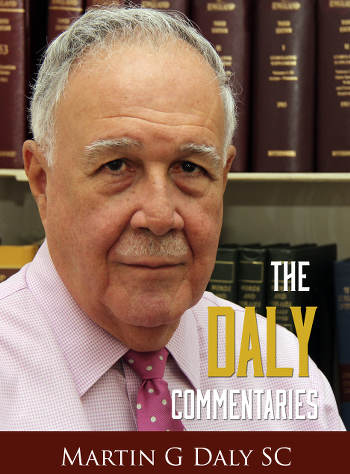
Martin G Daly SC is a prominent attorney-at-law. He is a former Independent Senator and past president of the Law Association of Trinidad and Tobago.
He is chairman of the Pat Bishop Foundation and a steelpan music enthusiast.