 Wired868 Wired868 for smart sport news and opinion
“[…] The Home Invasion Bill does not expand rights for householders. It does not reshape murder elements… What it does do is reassure the public that the law stands with terrified defenders. Again: courts already did that.
“So why does the Bill exist at all? The honest answer is the same in every Commonwealth Parliament that has ever responded to moral outrage. It exists because public confidence needed a hug…”
The following Letter to the Editor, an analysis of the Home Invasion Bill 2025, recently passed in parliament, was submitted to Wired868 by legal advisor Mohan Ramcharan:

Photo: UNC.
The Home Invasion (Self-Defence and Defence of Property) Bill 2025 was passed in Trinidad and Tobago with enthusiastic political fanfare and was later confirmed as an Act of Parliament.
The applause is understandable. Home invasions, violent robberies, and predatory killings have exhausted public patience.
When voters are tired, legislators reach for the statute book. When legislators are tired, they reach for dramatic phrasing. When lawyers are tired, they reach for the fine print. Let us now do the latter.
England and Wales—whose common law has been inherited across the Commonwealth unless expressly displaced—does not operate a felony/ misdemeanour classification. That was abolished here in 1967.

Trinidad and Tobago’s criminal statutes likewise do not organise crimes as “felonies”. We prosecute and defend on the elements of offences, not transcontinental labels borrowed from US primetime.
What the Bill does achieve, with genuine legal novelty, is the creation of a new statutory offence named home invasion, complete with aggravating features (gang participation, weapons, the presence of a child, disability, or other vulnerability) and heavy custodial consequences. Good.
Legislatures should define the conduct they wish to criminalise. Clause 5 sets out those ingredients clearly.

Where the Bill then loses its way—and where my commentary must be delivered with a spoonful of satire—is the suggestion that homicide law required moral reconstruction. It did not. It already contains it.
Murder, throughout Commonwealth doctrine, still requires intent to kill or intent to cause very serious harm. This is not an American jurisdiction. There is no “felony murder rule” in the UK or in T&T homicide law generally.
The Commonwealth equivalent for unintended deaths during a dangerous crime is unlawful act (constructive) manslaughter, not automatic moral elevation to murder by category.

The test for that principle was settled long ago in DPP v Newbury and Jones [1977] AC 500 (HL), which applies to the offence of manslaughter, not a fictional murder upgrade path triggered by an American term.
Self-defence doctrine, the part the public already had before the Bill was plated up, evaluates a defender on:
- Their honestly held belief in the threat (even if mistaken, provided it is genuine), and
- The reasonableness and proportionality of force wasassessed against the circumstances, fear, and immediacy they experienced.
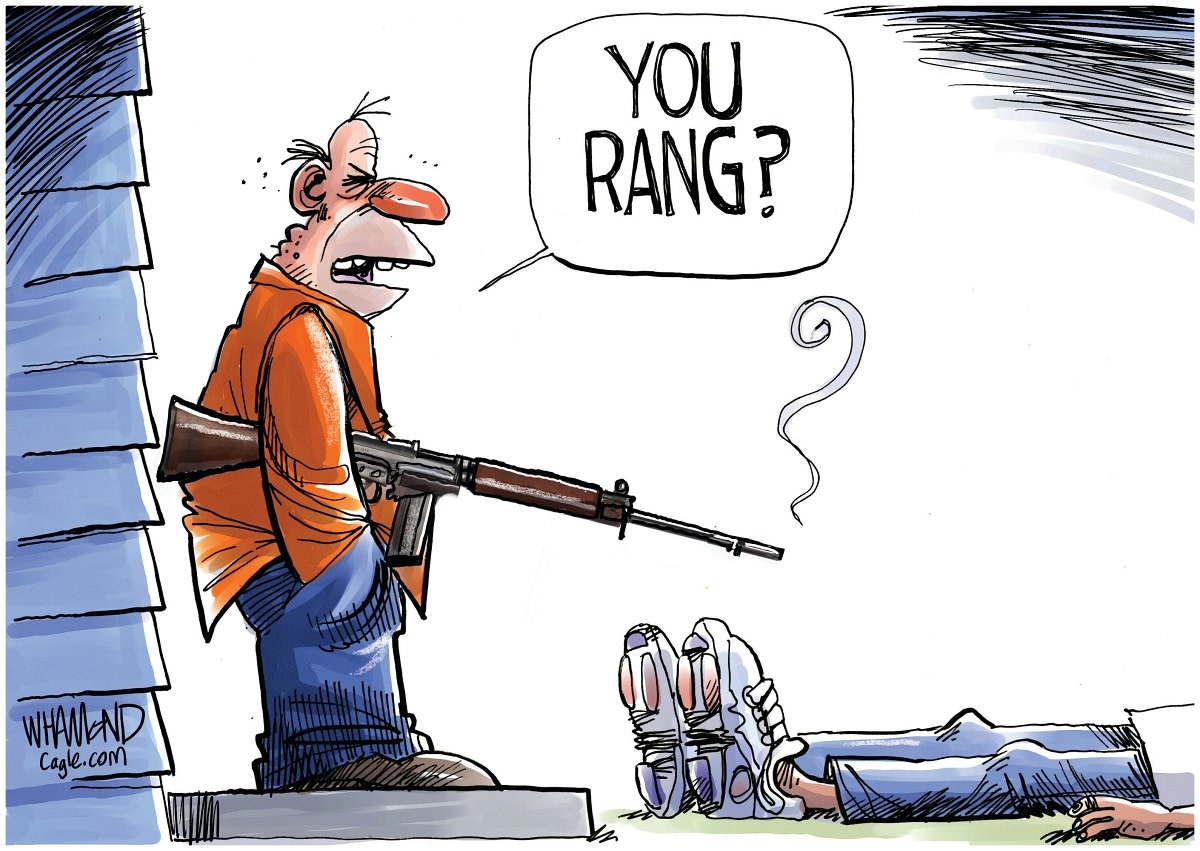
In England and Wales, this was settled in R v Williams (Gladstone) [1984] – 78 Cr App R 276 (CA) and R v Owino [1996] – 2 Cr App R 128 (CA).
In the Commonwealth, the same principles resonate not because a new Bill announced them, but because we all share the same legal DNA—the law we inherited from Westminster common-law reasoning, not Washington scriptwriting.
Thus, the Bill “fixes” the self-defence retreat rule only as a legal duty to retreat, not as a practical option. It tells defenders they have no legal obligation to flee. Fine. But courts never required that anyway if the tests are met. What they actually wrote was a safety net for juries and judges, not a revolution.
The suggestion that retreating from an intruder is “foolish if facing a deadly threat” deserves its own raised eyebrow.

Retreating towards safety is clever. Retreating towards danger is the plot of every thriller where the hero runs upstairs instead of out the front door. The statute makers apparently felt that banning retreat altogether would calm the masses.
In reality, banning retreat as a legal duty merely confirms what the courts already do: apply context, belief, and reasonableness, not myths of bravado.
The Bill does not expand rights for householders. It does not reshape murder elements. It does not import an American felony murder doctrine that never docked in Port of Spain.
What it does do is reassure the public that the law stands with terrified defenders. Again: courts already did that.

Photo: Office of the President.
So why does the Bill exist at all? The honest answer is the same in every Commonwealth Parliament that has ever responded to moral outrage. It exists because public confidence needed a hug, not because homicide doctrine needed a patch.
It is the legislative equivalent of political comfort food:
- A new offence is created—the nutritious bit.
- An unnecessary doctrine is invoked—the seasoning nobody asked for.
- And an old defence is re-plated—the legal carbs.
- All served hot to appease a public weary of violent crime.
Nothing wrong with signalling societal outrage through legislation. But dressing the Act up as a doctrinal rescue mission, while smuggling in US homicide shorthand, is a bit like seasoning roti with ranch dressing: flavourful commentary for telly, but perplexing for the legal kitchen.

Trinidad and Tobago law applies Commonwealth self-defence principles inherited from the UK and the Commonwealth—unless local statutes clearly replace them—but T&T has not replaced murder intent or created felony categories.
And human rights? They are universal, indivisible, and inherent. Criminal offences, meanwhile, are built from statutory elements and factual scrutiny. The former protects all humans. The latter expects lawyers to protect logic.
Let us educate the public widely—on the law, not the limelight. And let us hope that next time an op-ed praises an Act, they have read it first, rather than citing a homicide rule borrowed from US drama reels like legal confetti.
Editor’s Note: Click HERE for a rebuttal of Mohan Ramcharan’s commentary by Ula Nathai-Lutchman, an international barrister at law with over 20 years of experience in international criminal, human rights, and administrative law across the Commonwealth, Caribbean & international legal frameworks.
“[…] It is clear that this Administration, having outsourced its decision-making with respect to relations with Venezuela, has not learnt Read more

A little over a week ago, on 29 November 2025, the Washington Post identified “the Caribbean allies helping the US Read more
“[…] Critics may dismiss the [Home Invasion] Bill as mere ‘political comfort food’. Its purpose is practical: to bridge gaps Read more

October and Calypso History Month are behind us now. February and Season 2026 beckon. What lies ahead? What is in Read more

However the intended and laudable “revitalisation” of Trinidad and Tobago may proceed, the long standing need for socio-economic reform, accountable Read more

On 31 October 2025, Attorney General Senator John Jeremie SC gave the House of Representatives the Government’s rationale for an Read more

Mohan Ramcharan is a Trinidadian living in England, an LLB (Hons) law graduate, systems thinking practitioner, and critical thinker. He is a product of two cultures and strives to be ethical and impartial in his thoughts and actions.