 Wired868 Wired868 for smart sport news and opinion
“[…] What is perhaps most instructive from the data on Trinidad and Tobago’s national culture is our incredibly low score on long-term orientation (17 out of 100 vs 77 out of 100 in China and 50 out of 100 in the US).
“It demonstrates a low propensity to sufficiently consider the future, and a focus on achieving quick results. Against this backdrop, it is unsurprising to observe that we can easily engage in problematic behaviours and change rules to achieve a desired outcome, without sufficiently considering the long-term effects.
“[…] Many lament that Carnival is different today to that of yesteryear. It is. It is more commercialised, less inclusive and more flash…”

The following guest column on Dutch social psychologist Geert Hofstede’s measurement of Trinidad and Tobago’s culture and how it might be reflected in our Carnival and calypso was submitted to Wired868 by Dr Jamelia Harris, an economist:
The topic of culture has been at the fore, having just celebrated our carnival season.
Carnival, with its roots in rebellion and resistance, is now one of the most visible manifestations of our cultural expression. We celebrate, and share with the world our unique music, dance, carnival characters, and food.

Carnival, like most tangible expressions of culture is precious. And like most things precious, there is often a fight to preserve it and a fight for ownership.
The debates that follow the season are therefore expected. What is the direction of travel for calypso? What makes a calypso good (or not)? Who owns the right to determine what is a good calypso? Should a cultural icon be more revered if they both write and sing their own original compositions?
We often dismiss these debates as the usual bacchanal around Carnival, but they also represent serious discussions on how our culture is showcased. And importantly, the extent to which we are comfortable with how it changes, and who decides how it changes.

Photo: TUCO.
But cultural expressions do not simply change because a political or corporate body says so. They change because we accept the change. And we accept the change when our culture changes.
So, what is culture?
Culture is distinct from cultural expressions. But the two are intrinsically related. Culture is the shared system of values, beliefs, customs and behaviours. Culture, in turn, shapes cultural expressions, such as song, dance, art, food, etc.
Photo: NCC.
There is no universally agreed way to measure culture, but thanks to a good friend, I recently discovered a very instructive measure: Geert Hofstede 6-D model of national culture.
The model measures national culture using six dimensions, while recognising that the list of dimensions included is not exhaustive. The dimensions include:
- ‘Power distance’, or the extent to which less powerful members of society accept that power is unequally distributed;
- ‘Individualism vs collectivism’, that is, if society is defined around “I” vs “we”;
- ‘Motivation toward success’, which measures cultural value placed on competitiveness, assertiveness, and material success;
- ‘Uncertainty avoidance’, or a society’s tolerance for ambiguity and uncertainty.
- ‘Long-term orientation’, which prioritises future rewards, perseverance and thrift;
- ‘Indulgence’, which measures the extent to which people try to control their desires and impulses.
- Source: The Culture Factor Group
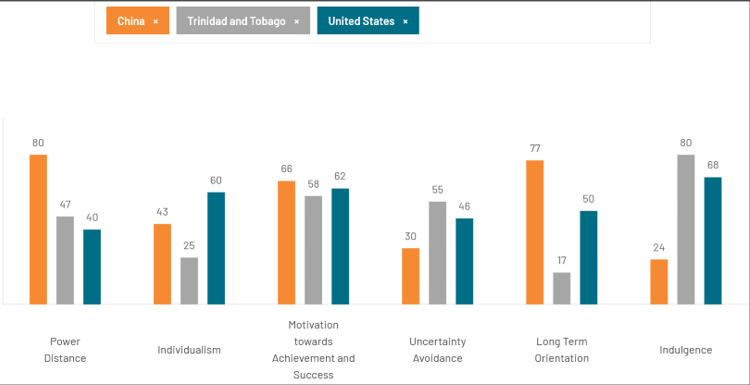
Unsurprisingly, Trinidad and Tobago, is a very indulgent society (scoring 80 out of 100). Even more so than the US (68 out of 100), and significantly more than a restrained society like China (24 out of100).
Many, not all, aspects of carnival reflect this cultural value of indulgence. One of the most infectious songs of the season, Voice’s Cyah Behave, chronicles lack of restraint.
According to the data, we are also a very collective society. TT scores 25 out of 100 for individualism, compared to the more individualistic US (60 out of 100), and socially-oriented China (43 out of 100). This collectivism is often reflected in our calypso.
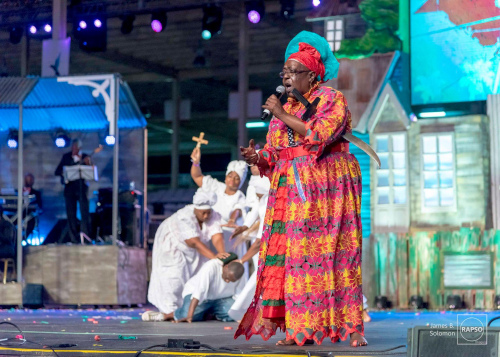
Photo: James Solomon.
The Mighty Chalkdust once described a good calypso as both “timely and timeless”.
The greats that have endured are from griots who told stories of our collective political history (e.g. The Mighty Sparrow’s Federation), our shared economic woos (e.g. Gypsy’s The sinking ship), and social ills that affect our communities (e.g. the late Singing Sandra’s Voices from the Ghetto).
They have also lifted our collective morale in nation building renditions like the late-Black Stalin’s We can make it if we try.

Photo: NCCTT.
What is perhaps most instructive from the data is our incredibly low score on long-term orientation (17 out of 100 vs 77 out of 100 in China and 50 out of 100 in the US). It demonstrates a low propensity to sufficiently consider the future, and a focus on achieving quick results.
Against this backdrop, it is unsurprising to observe that we can easily engage in problematic behaviours and change rules to achieve a desired outcome, without sufficiently considering the long-term effects. The (short-term) ends justify the means.
Many lament that Carnival is different today to that of yesteryear. It is. It is more commercialised, less inclusive and more “flash”.
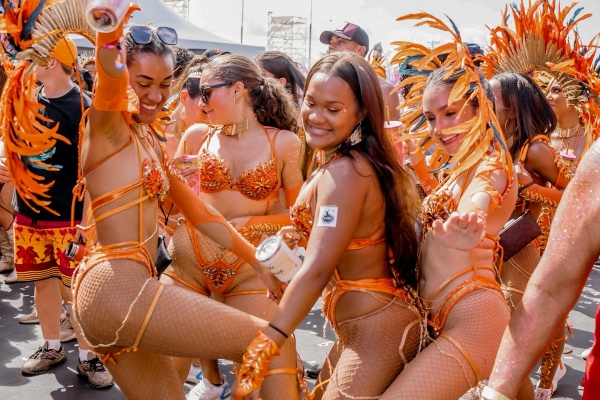
Many believe the ground no longer carries it, as Bunji Garlin masterfully articulated in 2025. But it did not change overnight. It changed, as cultural expressions do—because our culture has changed to become more capitalist and by extension more commercialised, less inclusive and more flash.
There has also been an increasing tendency to shift the meaning of collectivism. Instead of a universal “we”, the country is tending to an “us vs them”.
If our national culture redefines and silos the collective in terms of race and political affiliation, our expressions like calypso are produced and received through this lens.
Us vs them is not collective, it sows seeds of division. It destroys the collective.

So, if we question how our calypso, our Carnival, is changing as a cultural expression, we should seek to understand what about our culture is driving this change.
It begs the question: what will happen to our cultural expressions if our national culture becomes less collective? Less willing to challenge power relationships? More focused on material success? More indulgent?
At the 2026 Dimanche Gras, Helon Francis sang the refrain: “tell me where, tell me where else can we go” in his contribution Doh Forget.
The answer to that lies in how we—the collective we—allow our national culture to change.
Thirteen years have passed since health care workers, Lake Asphalt employees and other workers last received a salary adjustment. In Read more
Having just celebrated 64 years of independence, discussions as to whether Trinidad and Tobago is better off since gaining independence Read more
“[…] To the ‘UNC family’ she offers the old tired hymn: lagoons, cane fields, salt and rice, ponds and springs—the Read more

Some years ago, I lived and worked in Sierra Leone. I arrived in the capital, Freetown, just ten years after Read more

“[…] The media release by the heads of judiciaries—that seemed to focus on the leak of the emails and breach Read more
“[…] Neither African nor Indian communities benefit from this… In cases where division arises unintentionally, accountability must fall on leaders, Read more

Want to share your thoughts with Wired868? Email us at editor@wired868.com.
Please keep your letter between 300 to 600 words and be sure to read it over first for typos and punctuation.
We don’t publish anonymously unless there is a good reason, such as an obvious threat of harassment or job loss.