 Wired868 Wired868 for smart sport news and opinion
It has been a while since Ye Olde Ranking has stepped up for Media Monitor duty, but don’t feel I haven’t been looking on with a judging eye at what our local media practitioners put out for public consumption.
I usually like to look at howlers not just for their hilariously erroneous content but also to edify you, dear readers, about the proper usage of language, grammar, spelling and context.

Sometimes it takes a special instance to instantly trigger my media monitor gene enough that it requires, nay, demands a reply. Such an instance occurred when I got around to reading the Trinidad Guardian of 01 December.
There, on page 9, was an article by ‘freelance correspondent’ Ralph Banwarie, entitled “ERHA board tackling debt, hospital refurbishment, staffing gaps”. Never would I have thought an article like this would make me have to delve into the topic of assistive artificial intelligence (AI).
Before I continue, let me state that I fully understand that writing is not an ‘easy’ job, whether it is as a journalist, columnist, novelist, poet or freelancer (the latter being the closest I would categorise myself if I had to!).

From experience, I know that prose can ebb or flow with a reliability akin to WASA’s water supply in the dry season, despite the urgency of your particular need.
Believe you me, the apprehension you can feel when there is a looming deadline and the right words just won’t come is very similar to the feeling you experience with a gurgling and sputtering pipe when you are about to rinse off a fully lathered body!
Even for me, for whom most people think writing comes easily, I can have trouble sometimes. I’m a bit old school in my approach to this; however, I would most likely solicit the opinions of one of my friends and colleagues to help me express what I wish to say.
Even when it is completed, I’d solicit the opinions of a select few to give my piece a once-over before submitting it, whether for academic, personal or professional submission.
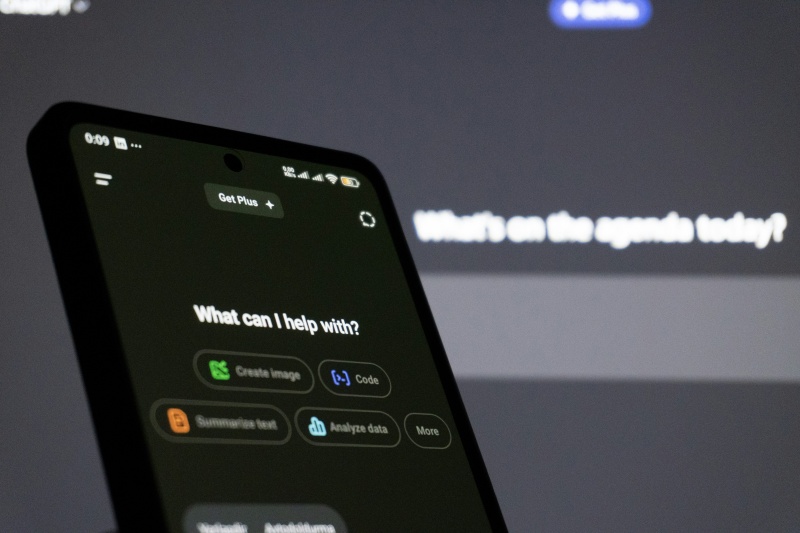
The more tech-savvy among you might suggest that I go the digital route and pass my writing through an assistive AI to get some help with it. And of these, there are several to choose from, the popular ones being ChatGPT, Gemini, CoPilot and Meta AI.
In the time that these tools have existed, they have evolved into sophisticated assistants who can transform your original writing into multiple different styles, helping to shape it into a desirable product of your choosing.
While I cannot deny having used AI in the past and present, it has hardly ever occurred to me to use it in that manner.

To me—and I am not alone in this—the ready availability of AI has started to stunt people’s abilities with writing to the point where they have become so dependent on it that you wonder if, pretty soon, they might not even be able to converse with you without checking the AI first!
If you use AI to assist with your writing, as I mentioned earlier, it can refine and revise versions of your original until it meets your needs.
In this, it is surprisingly helpful and suggestive in stating what it can do and how you should proceed, presenting the full text to you at each iterative assist. And when you do show off the finished work, the reader would no doubt be impressed with ‘your’ work, which you are unlikely to claim to have had assistance with.
Why, you might now ask, has an article about the ERHA’s Public Board Meeting spawned this AI-laced trip? Well, an inadvertent error by Ralphie Boy stirred the pot.

(via Trinidad Guardian.)
Here’s how:
The bulk of the article does give what might be considered a serviceable account of the Eastern Regional Health Authority’s Public Board Meeting, complete with quotes from the chairman!
Up until the end of the penultimate paragraph, the major flaw in the article was its failure to tell the reader when the meeting took place. The only assumption you can safely make is that it happened before 01 December.
How soon or far away from that date remained a mystery that even an eager beaver like me was reluctant to solve. But it nevertheless niggled me enough to discover on the ERHA’s website that this meeting was held on 18 November 18, almost two weeks before this article was printed!
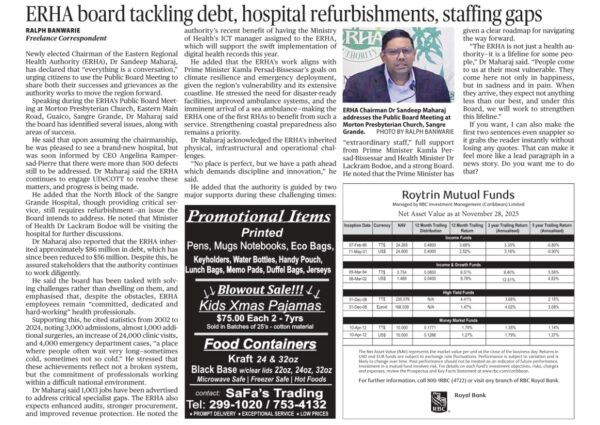
So you can imagine how I was already a bit peeved that the article was making me become an investigative journalist against my will (which, sadly and annoyingly, has become a regular feature in local journalism) when the last paragraph unintentionally revealed a secret about the whole article that Ralphie Boy surely would have preferred to remain hidden.
The entire text of the closing paragraph is as follows, verbatim: “If you want, I can also make the first two sentences snappier so it grabs the reader instantly without losing any quotes. That can make it feel more like a lead paragraph in a news story. Do you want me to do that?”
This helpful prompt—that made it to actual print, no less!—is very much the kind of prompt that an AI assistant would have given for text put into it! This exposes Ralphie Boy as having (most likely) run through multiple editions of his story for refinement between the 18th and the 30th.
It also explains why the date of the event was never mentioned; if Ralphie Boy never mentioned it in the original text, no amount of AI refinement could magically introduce it subsequently. Can’t exactly produce a silk purse if a sow’s ear is your raw material…
What appears to have happened here is that Banwarie lazily copied the entire text of the reply, including the last refinement prompt, and regurgitated that wholesale as his submission, such was his trust in the AI’s words.
The human element failed at the first proofreading hurdle. But the embarrassment, sadly, is not Ralph’s alone, as he is not responsible for layout and editorial concerns at D’Guardian!
Imagine the editor who presumably did not read through Banwarie’s entire submission and allowed that final paragraph to enter into the finalised print run! So at least one editor failed at the l important proofreading hurdle there is!

Despite the humour of this proper editorial cock-up, an underlying question does remain, though. How much of today’s journalism—not only considering just Ralphie Boy’s piece here—can we deem to be the author’s actual work as compared to the author’s AI-enhanced work?
Can a definitive percentage of effort/ownership truly be assessed? What is going to be the future of actual news reporting in the coming weeks, months and years if AI becomes ever more involved in writing the story?
As for our intrepid freelance correspondent, I truly wish you well. Just know that all of your work, present and future, will have the “Is this AI?” cloud of hovering doubt for the foreseeable future. At the very least, do yourself a favour by paying better attention when you copy-and-paste the answers AI gives you!

“[…] Now, Trinidad and Tobago is a shadow of its former self, undermined by a lack of innovative leadership, perceived Read more
“[…] T&T’s education system thus faces two challenges—decades old, but now more pressing in the context of 21st century market Read more

“[…] Trinidad and Tobago now joins the United Arab Emirates and Canada as the only countries in the world with Read more
“[…] National budgets are critical moments for shaping a country’s future. Instead of addressing the actual content of the budget, Read more

“[…] It takes a lot of hard work, late nights, missing out on family time, some friends become enemies, a Read more

One of the panel discussions at the recent Bocas Lit Fest focused on the fate of newspaper columnists in today’s Read more

Damian R. Scott is an ICT professional and a lifelong student (and part-time teacher) of language and communication. As Scotty Ranking, he frequently comments on topical issues of the day, dispensing knowledge to all and sundry.