 Wired868 Wired868 for smart sport news and opinion
There was an outpouring of sympathy for the Venezuelan children and women, who were brought to our shores, after enduring cold weather and the high seas. And that is as it should be.
However, there is no wailing for our own fates as represented by this turn of events. This event signals our final descent into unimportance—regionally and in geo-political terms. We have to now pay the price for ill-informed behaviour over several years.

Our nation has for many decades enjoyed economic rents driven by strategic location and our oil then gas reserves. BPTT accounted for about 15% of BP’s global production and a former chairman Lord John Browne once described it as a ‘crown jewel’.
Since Independence, we have embarked on pseudo-development strategies that never brought sustained and progressive economic viability. We have remained vulnerable, like the hapless migrants, bobbing up and down in a perilous environment.
In spite of our illusory high per capita income, there are wide swaths of poor people who live on our coastlines, be it Chaguaramas or Erin, seduced by the wiles of modern-day pirates, to open our doors. Indeed, our poorest live on the south coast between Icacos and Moruga.
Even though we are a small nation, we had influence (getting others to go along with you) both within and out of the region. We dominated the regional trade and was the provider of financial resources to others who needed investments.
We joined the Organisation of American States (OAS) in 1967 and with the entry of other Caribbean nations wielded much sway, in much the same manner that Jack Warner later welded the Concacaf as a power bloc.

In 1985, we got the OAS to remove the Charter provision that restricted the entry of Guyana and Belize into that grouping. We forgave US$360 million of a US$536 million debt owed by Guyana in 2005, as part of the global debt relief programme. Our Regiment have long been first responders for hurricane ravaged islands.
As late as 1994, we were instrumental in the formation of the Association of Caribbean States, an outreach to promote functional cooperation and free trade between the Caribbean and Central America.
In 2002, Caricom, as a unit, supported the OAS Resolution 833 recognising Hugo Chavez as the democratically elected President of Venezuela against the wishes of the USA and shortly after an attempted coup. But between 2017 and 2019, on four other resolutions, Caricom split into three groups: pro Venezuela, pro USA and those, including us, who abstain.
Why did this happen? Structurally, there were developments on the energy front that undermined our position. The Petro Caribe agreement upended our hold on energy supply to the region.
Venezuela provided the oil at a lower price than Trinidad could but that did not result in lower electricity prices for the citizens, as some countries used the ‘savings’ to run their budgets. This was coupled with missteps by the Patrick Manning-led administration in negotiations with Jamaica.

Then as a means of counteracting the Chavez spread of influence, there was the rise of the Overseas Private Investment Corporation, a US government inspired vehicle, which made Jamaica the largest solar energy player in the region and also induced three others to cleave to the USA—whose LNG purchases from us began to decline.
Unlike President George W Bush who met all the Caricom leaders in 2007, President Donald Trump only had time for this small group.
The disputed Shiprider Agreement negotiated in 1996, which allows for the US Coast Guard to board suspect vessels for narcotics, was being enforced as recently as 2017 in Jamaica and is now being enforced in Guyana with the recent trip of Secretary Mike Pompeo.
We, on the other hand, are unable to protect our coastline due to inconsistency of purpose between two administrations. The incoming prime minister, in 2010, scoffed at the ideas advanced by her predecessor:
“[…] Do we need three OPVs? The country is not at war out in the seas; the country is at war on the ground, in our streets and in the towns within T&T.

“[…] The cost to maintain the vessels would have cost taxpayers in excess of $500 million annually. Our country cannot sustain that at this time.”
This drama sadly continues today in our Parliament.
In Washington DC, a place of immense influence, the veteran Ambassador Christopher Thomas was replaced by Dr Neil Parsan, a veritable neophyte.
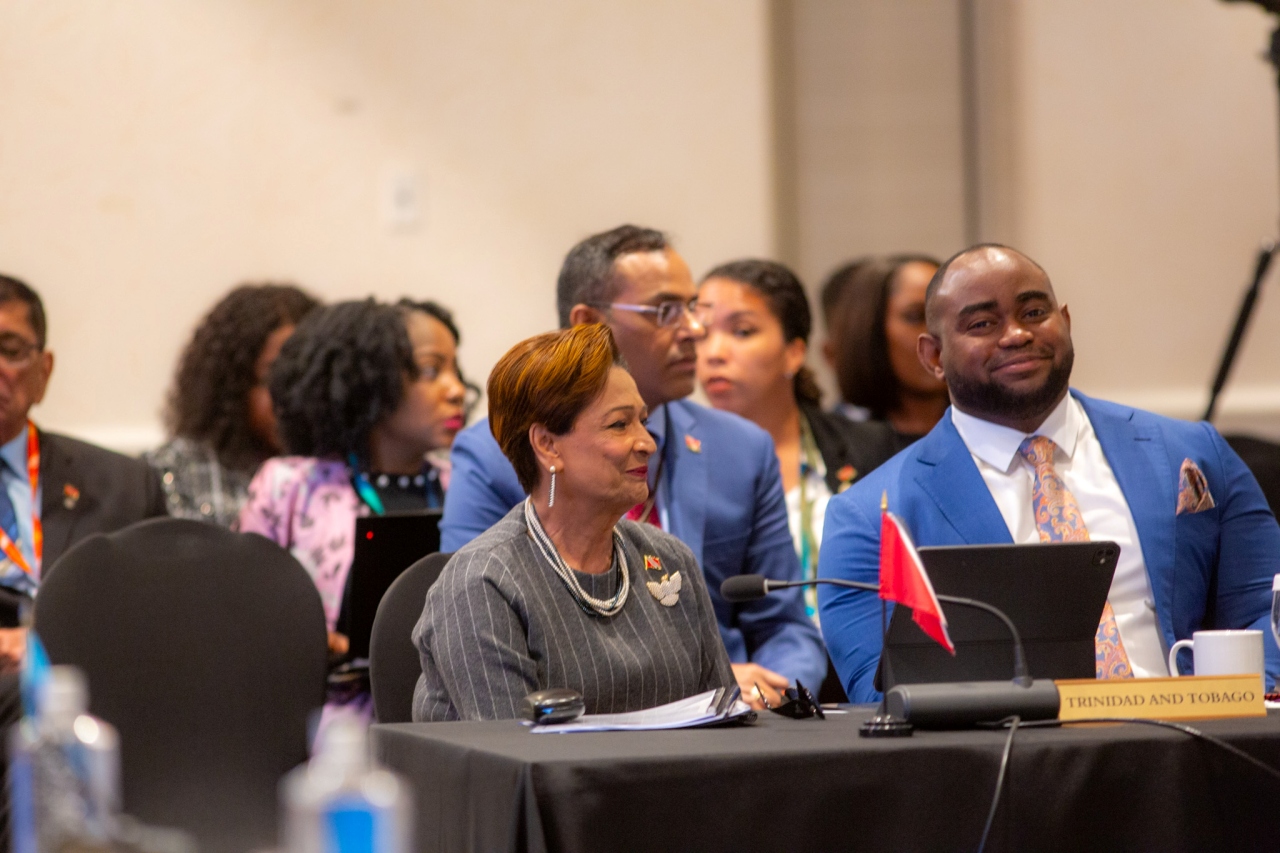
Without provocation, Mrs Kamla Persad-Bissessar told Caricom that we were not an ‘ATM’! Like a Harvard Club youth cricketer dismissing Brian Lara’s advice, she fobbed off PJ Patterson’s remonstrance.
We followed up with the appointment of an invisible foreign affairs minister and the ineptitude present in the 2016 Eden Charles debacle and the 2018 Dominica OAS fiasco.
Dedicated public servants are at risk from those less capable. Institutional knowledge is drained. We fail to recognise that networks are people-based and are built on mutual trust.

(Copyright Noel Thompson/Jamaica Gleaner)
Now, Guyana has oil and Exxon (to understand the full impact, read Steve Coll’s 2013 book ‘Private Empire’). Jamaica is leveraging their energy advances to create more operational space for their economy. Their policy continuity between administrations creates fiscal space.
On the other hand, we have the migrants and those who would run to Marli Street. To do differently requires a national plan helped by a mediating private sector leadership and a rebuilt competent civil service.
I am not a politician. I’m certainly not a senator. I am just a citizen who pays attention. So, when Read more
“[…] To the ‘UNC family’ she offers the old tired hymn: lagoons, cane fields, salt and rice, ponds and springs—the Read more
Three thousand dollars a month. That’s the minimum National Insurance pension a citizen receives after a lifetime of work. It’s Read more
The UNC won the 2025 general elections promising to transform Trinidad and Tobago’s economic fortunes, treat workers fairly and address Read more

The danger was never the word. The danger… was that it sounded familiar. Once upon a time, leadership had a Read more

Truth be told, Dr Keith Rowley should have held his tongue—he does not have the moral high ground. He should Read more
Noble Philip, a retired business executive, is trying to interpret Jesus’ relationships with the poor and rich among us. A Seeker, not a Saint.